Category Archives: Spirituality

“Icons” of Hope and Encouragement

In 1997, when Fred Rogers (Mr. Rogers) received an Emmy Award for his Lifetime Achievement in children’s television, his acceptance speech famously included an exercise, during which he invited audience members to spend just 10 seconds calling to mind people who had made a difference in their lives, who had helped them become who they are. Reportedly, that short reflection proved marvelously rich for those in attendance, many of whom were left misty-eyed by the experience.

While I wasn’t present for that award ceremony, I have viewed the video capturing that special moment multiple times, and it easily brings me to tears as well. When I take the time, even just the recommended 10 seconds, my mind can easily summon the faces of many good people, “icons,” if you will, of hope and encouragement, who have aided me along life’s path. Some are faces I would fully expect — family members, close friends, etc. — but others are faces of people whose lives only intersected with mine for a short period of time, yet their influence undeniably remains.

In the spirit of Mr. Rogers’ exercise, please allow me to introduce three such people, who have helped to make me the person I am today.

Jimmy, the Ice Cream Man

When I think of Jimmy, even after these many years, my heart smiles. He is someone from my childhood, who I knew virtually nothing about, except for the fact that his truck would turn the corner onto our street at roughly the same time every summer evening. He would then sound his familiar bell while pulling over to the right side of the road. The children of our neighborhood, myself included, would always be ready for him, clutching the coins our parents had given us, watching and listening together.

Jimmy was a heavy-set man, who moved slowly within the tight confines of his mobile ice cream shop. He was never unfriendly, but he spoke sparingly to his young customers, often soliciting each next order by a quick nod of the head.

He had an olive complexion, thick hands, slightly bulging eyes, and a round face that toggled between a smile and a smirk — a face that remains vividly accessible to me even today.

Yes, Jimmy served us creamsicles, strawberry shortcakes, fudge pops, and a variety of Italian ices, but those were not his only wares. Perhaps unbeknownst to him, Jimmy also served us innocent fun on a stick or in a cup. He served us a predictable rhythm in our young lives, an experience of shared expectation and joy. He brought us together on a common quest and helped to shape those blessedly simple summer evenings that bonded us in friendship.

Though Jimmy visited our neighborhood for the final time decades ago, he often still turns that corner and rings his bell in my cherished memories.

—-

Sister Mary Ann Follmar

“Follmar anxiety” cannot be found in the DSM-5, but it felt very real to my friend Liz and me when we were graduate students together in Sr. Mary Ann Follmar’s classes at Providence College. The faux ailment was a comical label Liz and I attached to our stressed-out frame(s) of mind when charged with writing research papers for our remarkable professor.

Holiness is not a measurable commodity, but when one is in the presence of a truly holy person, it is certainly discernible. I’m not referring here to an aura that sometimes accompanies celebrity. Instead, I’m speaking about an otherworldly quality that can be difficult to describe.

Christian theology asserts that God is holiness itself. In this view, God is perfectly pure and thus separated from all that is sinful. For a person to be holy, therefore, is for that person to manifest God-like qualities, i.e., to be similarly — though imperfectly — separated from sinfulness. I believe this quality of separateness is what people intuit when in the presence of a holy person.

Sr. Mary Ann exhibited such separateness, perhaps more strongly than anyone else I have ever encountered; however, rather than making her seem distant or unreal, the separateness manifested as deep joy and peace and thus acted as a powerfully attractive force. It was not unusual, for example, to find students gathered around Sr. Mary Ann at her desk before or after a class or even in the dining hall. She was also known to invite groups of students to her apartment for prayer, and many enthusiastically accepted.

Though known as Sister Mary Ann, she was not a nun; rather, she was a consecrated virgin in the Dominican tradition, who lived alone and spent several hours each day in Eucharistic adoration. The fruit of her devotion was powerfully evident.

Though she had no immediate family of her own in Providence, she took absolute delight in children, including our first child, Rachel, who was only four months old when I started my degree program. Sr. Mary Ann would positively beam in Rachel’s presence and was always eager to hold her, even if Rachel was having a fussy episode.

When my sister Christine passed away early in the spring semester of 1985, Sr. Mary Ann traveled with another of my professors, Fr. Giles Dimock, O.P., from Rhode Island to our hometown just outside of Boston for Christine’s funeral. Her (and Fr. Giles’) presence and support at that acutely vulnerable time meant a very great deal to me.

Sr. Mary Ann’s influence, in the classroom and (especially) through the witness of her beautiful life, made holiness seem possible for her students, including me. I doubt that spirituality would hold the same treasured place in my life if not for her. I will be forever grateful.

—-

Theodore “Ted” Vrettos

Ted Vrettos had a “yes” face that could easily transition into a mischievous grin. His laid-back classroom style put his students at ease and helped create a safe forum for creative expression.

I first met Ted when I enrolled in his basic Creative Writing class at Salem State College in the late 1970s. I had no idea at the time how much richer my life would be because of that encounter.

An endearing man, Ted was about 60 years old and an accomplished writer when I became his student. Thinking back, I struggle to recall anything that Ted actually taught me about the craft of creative writing. He did, however, do two things that I consider far more important. He encouraged my discipline as a writer, at least for as long as I was in his classes; and, he helped me to find and shape my writer’s voice.

I believe I took three classes in all with Ted and then finished up by participating in his summer writer’s conference in 1980. Beginning with my second class and continuing right through the writer’s conference, I was part of a committed group of Ted’s students, who took creative writing seriously and became very good friends. Four of them remain my close friends today, some 45+ years later. And, most of us continue to write.

In Ted’s classes, the desks in the room were always arranged in a circle. Ted would enter with his briefcase and assume his place at one of the desks in the front of the class. If he had given an assignment, he would begin there, but most of the time he would simply invite anyone with a newly written piece to read it aloud so that he and the class could critique it. The experience could be exhilarating, unnerving, even embarrassing, but we willingly subjected ourselves to the process because our desire was so strong.

A couple of years after graduation, someone from our group had the idea that we should get together again informally with Ted. My wife and I offered to host, and I reached out to Ted to see if he would consider joining us. He quickly agreed to come and asked if his wife Vas could also join in. In preparation, several of us, including me, wrote new stories to read to the group.

When the night came, we broke bread together, socialized for a while, and then fell back into our familiar pattern of sharing and critiquing. It was wonderful.

I saw Ted two more times in the early 1990s. First, I dropped by his house to invite him to come and speak at a Library Week program that would take place in the public library where I began my career. He was warm and welcoming as usual, and Vas prepared me a delicious lunch. He also agreed to come.

Our final encounter was a few weeks later at our Library Week program. Ted shared about his published books on the topic of Lord Elgin and his controversial removal of the Parthenon Marbles in the early years of the 19th century. He spoke eloquently, and the audience was very engaged. So, I was delighted with the program; but, I was sad to see it end. I sensed that my old mentor and I might never cross paths again after that night. That proved to be the case.

—-

At the end of December, I will be retiring from Boston College. It was not an easy decision because I genuinely love my job. Still, it’s time.

Being both naturally introspective and quite sentimental, I find myself in a reminiscing mood as the final days of my career tick by. Curiously, I’m not thinking at all about achievements through the years. They may have once been quite important, but their significance fades with time. Instead, my mind is occupied by the wonderful people I’ve been blessed to meet, work with, and serve during my career. It’s really all about them… and you.

“Jimmy, the ice cream man,” Sr. Mary Ann Follmar, and Ted Vrettos are all gone today.

I wish I’d had a final chance to say, “good-bye,” and to tell them how important they were (and are) to me.

I wish I had let them know that I love them.

—-

If you have been a part of my life, my work, or both, whenever I reserve 10 seconds (or more) to consider my helpers, your face may come to mind as one of my “icons.” Thank you! 

And, just so you know, I love you too!

Holy Ground

“… put off your shoes from your feet, for the place on which you are standing is holy ground.” (Exodus 3:5b RSVCE)

_

Just imagining the scene conjures up a swirl of emotions.

Her plot was hatched even as she watched the workers pour the thick mixture into the square form and smooth it with a trowel. She knew this much, the job to be done must be carried out in secret.

As afternoon yielded to early evening, while her Mom was occupied with preparing dinner, she sensed her opportunity. Clutching the popsicle stick she’d retrieved from her toy box, the wispy young girl slipped out the front door and crept purposefully toward the still-damp concrete. The naughtiness of her intention was unfamiliar but somehow exhilarating.

She glanced in all directions before moving aside one of the orange cones and kneeling next to her target. She would employ a light touch…

I once had the grand opportunity to visit the Hermitage Museum in St. Petersburg, Russia. As I moved slowly from gallery to gallery, viewing works of art by many of history’s great masters, including Rembrandt’s “The Return of the Prodigal Son,” I was spellbound. I also found myself oddly preoccupied by two things: 1.) the realization that each of these treasures began as a blank canvas and later became a masterpiece; and, 2.) a fascination with the various artists’ signatures.

Not all artists choose to sign their work. Some, however, make the distinctiveness of their signature a true part of their artistry.

Our granddaughter Therese, known affectionately to friends and family as T, has a flair for art that was evident quite early in her life. Though never one to draw attention to herself, Therese clearly understands the value of a distinctive signature. 

When she was thirteen, Therese was commissioned by her Gramma (my wife, Marianne) to produce a painting of a bird. When we received the finished work, I noticed for the first time the uniqueness of Therese’s signature. Note the period (.) before rather than after the capital T.

I once heard a conference speaker compare the experience of viewing a great painting by one of the masters to viewing a digital reproduction of the same painting. He admitted that the reproduction would lack the original’s capacity to inspire awe. He went on to say, however, that the digital reproduction should not be easily dismissed since advancements in digital photography now afford us the chance to study great paintings even at the brushstroke level.

I wonder how many thousands of brushstrokes Rembrandt used when painting “The Return of the Prodigal Son.” And, I wonder how many Therese used in creating her early masterpiece.

I still live in the small town where I was born and grew up. Its streets, neighborhoods, and even many of its residents are well known to me. It is, after all, home, and my roots run deep.

Maybe it’s characteristic of my age, but when I take walks today on these oh-so familiar streets, what had originally been intended as cardio exercise often becomes instead a mobile meditation through space/place and time. Memories are easily triggered. I also seem to notice things – or, more precisely, the significance of things – I have somehow missed before.

Locally, the practice seems to have ceased; however, for many years, the companies responsible for creating sidewalks in our town actually signed their work by embedding a small company plaque in the freshly poured concrete.

On a recent walk, I saw this:

What captured my attention was the date on the plaque, 1928. My father and mother, who also grew up in this town, were born in 1925 and 1926 respectively. So, they were toddlers when this sidewalk was created; and, since our town spans only 1.5 square miles, they had almost certainly walked on this very same sidewalk when they were children, adolescents, young adults, etc.

In a stunning moment of awareness, I sensed that a part of each of their stories had played out right here decades before. I suddenly felt a closeness to my parents that warmed my heart. Perhaps they had even walked by here together when their love was new and still enchanting. If so, I like to imagine that they were holding hands.

While caught up in this rumination, it dawned on me that F. J. McQueeney had, rather distinctively, signed a blank (concrete) canvas in 1928. Thereafter, it would be up to countless “artists,” over many generations, to finish the masterpiece.

All of the moments of all the lives lived atop McQueeney’s work were the brushstrokes.

I keep a soft, squishy ball that’s about the size of a softball atop the bureau in my bedroom. Most of the time, I pass by without even noticing it. Other times, however, it will catch my eye, and I’ll pick it up, squeeze it gently between both hands, and feel its inscape in my heart.

There’s a history with that ball that can’t be seen but can yet be deeply experienced, at least by a sentimental grandfather. Borrowing a concept from my favorite children’s book, The Velveteen Rabbit, that ball has become “real.” My grandson Joseph made it so. (But, that’s another story.)

I now see that McQueeney’s sidewalk is likewise “real.” All of us who have traveled its firm path have made it so  – and continue to make it so.

Consider, if you will…

Boys, in 1956, pitching their baseball cards toward the small retaining wall on the far side of the sidewalk – brushstroke

A brother and sister, in 1933, drawing a marvelously imperfect hopscotch grid in front of their home – brushstroke

An elderly woman, in 1962, slipping and falling on an untreated icy patch, thus beginning a steady decline in her health – (a tragic) brushstroke

A committed jogger, in 1978, stopping to check the intricate tread on her running shoes after accidentally stepping in something unpleasant – (a smelly) brushstroke

A father, in 1989, teaching his 6 year-old how to ride a bike and letting go at just the right time (even though he’d sort-of promised he wouldn’t) – brushstroke

A lovely bride, in 1994, leaving her childhood home and climbing into the limousine that would whisk her to the church and to a new life – brushstroke

A 47 year-old heart attack victim, in 2006, being wheeled from his home to a waiting ambulance with his nervous wife at his side – brushstroke

And so on…

After countless other brushstrokes, my late sister’s name in that sidewalk panel has faded over time. Truthfully, it was barely discernible from the start. Perhaps she really did deliberately employ a light touch, or, the concrete had already hardened to the point that making a deeper impression was just too difficult.

When I pass that way, I’ll often stop to study the spot. I know exactly where her name had been literally etched in stone, but the clarity of “Christine” is no more. That realization brings me sadness. Still, its gradual fading, while disappointing to her younger brother, may be appropriate.

Perhaps our brushstrokes are meant to fade. Then again, perhaps they don’t fade at all. They simply become invisibly “real” by blending with countless other brushstrokes that paint the human story.

Christine’s name and her memory have now become part of that sidewalk panel’s inscape, brushstrokes of a collective masterpiece.

—-

Tread lightly on the sidewalks in your life, for they are truly holy ground.

Thank you, F.J. McQueeney.

Gambling, Shame, and Oranges: A Leggy Love Story

And the man and his wife were both naked, and were not ashamed. (Gen 2:25)

If an afterlife affords us the chance to pose questions to the Almighty, I’ll have (at least) one at the ready. “Why are so many people – okay, okay, why was I – so prone to shame during my life?” And, if allowed a follow-up, “Why do so many of us – or, why did I – allow shame to wield such stifling power?”

My cousin Michael came to mind unexpectedly one day toward summer’s end. I was instantly awash in fond recollections but soon found myself shaking my head with the realization that he and I hadn’t seen one another in nearly 30 years.

Once, we’d been quite close. From boyhood into early adolescence, a trusted hallmark of summer was Michael’s annual two-week (sometimes longer) stay at my first family’s home. He was two years older than I; and, during those visits, I always felt as though I suddenly had a big brother watching out for me, guiding me.

Michael and I never had a falling out. As we grew older, our lives simply went in different directions, and we gradually lost contact. My only adult encounter with him was at our mutual uncle’s funeral in the mid-1990s. Unfortunately, that brief but warm reunion never led to further contact.

With my curiosity piqued on that late summer day, I searched for Michael online. To my surprise, one of the top Google results turned out to be his obituary. I discovered that he had passed away on January 1st of this year after what was described as a “hard fought battle with cancer.”

The happy memories that had rushed to mind just moments before were all now tinged with sadness.

Then, I thought about short pants.

—–

Michael’s final stay at our house was during the summer of 1971. I was thirteen years old and he was nearly sixteen. Since the previous summer, the difference in our ages had become more conspicuous, and the dynamic in our relationship followed suit. That summer, he was more interested in girls than in games, but I had yet to make such a transition.

One day during his visit, we took a bus ride during which he chatted up a couple of girls while I sat awkwardly by his side. To my discomfort, a plan was made to meet up with them again after dinner. I was very nervous but also determined to follow Michael’s lead.

After we’d eaten, he suggested that we change clothes for the scheduled rendezvous. I wasn’t sure why that was necessary but decided to go along. Once the bedroom door was closed for privacy, he looked at me quite matter-of-factly and spoke these indelicate – and, ultimately, indelible – words.

“Your legs are really ugly.  You should never wear shorts.”

Michael honestly cared about me and was not at all trying to be mean. Rather, in a big-brotherly way, he was trying to help me be more attractive to girls by encouraging me to hide one of my least attractive features. His concern wasn’t handled in the most sensitive of ways, but I’m certain it was well-intentioned.

Of course, I looked down at my legs, which I’d never really thought much about before, and I saw that they were indeed thin and bowed. I would never again be free of that awareness, which quickly morphed into shame. I peeled off the shorts I’d been wearing and pulled on a pair of bell bottom jeans.

“Much better,” he affirmed.

When I learned of Michael’s death, amidst the many memories, his “counsel” echoed loudly in my mind.

More than 50 years later, I still find even the thought of wearing short pants deeply disquieting.

I had crushes but never dated in high school. And, on the night of my senior prom, I went bowling. I had asked a young woman to be my prom date, but she politely declined. I simply couldn’t muster the courage to try again.

When my friends Rick and Pat picked me up, it was just getting dark. Enroute, we passed a couple of limousines, likely filled with some of my classmates. I crouched down in the seat and turned my face away from the window.

Pat must have noticed. “Are you okay?” he asked.

Unable to hide my embarrassment, I confessed that the prom was that evening, and I was not going.

Both were respectfully quiet for a few moments. Then, with a smile on his face, Rick blurted, “How about a dollar a string and a nickel a point?” A modest gamble always enhanced the experience for him.

“Works for me,” I responded, and we drove on.

I lost that night – twice, in fact, if you count the bowling, but my supportive friends softened the blow.

For much of my adolescence, I was wracked with shame and self-doubt. I had good friends, but love seemed unreachable or, at best, unsustainable. Then came Marianne.

I’ve never been much of a party person, even during my college years; so, choosing to attend the English Society’s end-of-semester gathering was a bit out of character. It helped, of course, that my friends Jimmy and Mike would also be there.

Wine in hand, the three of us were clustered together talking when a beautiful, unfamiliar young woman approached our group.

“Is this where the upperclassmen hang out?” she asked with a sweet smile. I was mesmerized.

These days, when recalling that moment, Marianne will say that she wondered why this guy’s eyes were so wide and staring. I wasn’t even aware of it at the time.

While the notion is very romantic, this was not an experience of love at first sight, though love would easily follow. Rather, and this is so difficult to explain, I knew at that moment, with a mysterious certainty, that I was staring at my future. The experience was like a stirring deep in my mind or heart or both that overwhelmed me.

If a brief conversation followed, I have no recollection of what was said. I’m not sure that I spoke at all, and I didn’t even get her name.

The party – and, with it, the academic year – ended, the crowd dispersed, and a long Marianne-less summer began. It would be my last such summer. In the ensuing months, I suspect my friends grew weary of my frequently expressed preoccupation.

“I know her,” my friend Jerry said at one point. “Her name is Marianne Auclair. She’s the friend of my friend Chris, and I’ll introduce you this fall.” His promise both terrified and thrilled me.

Eventually, September arrived. Unbeknownst to me, Jerry and Chris had worked out a plan to bring Marianne and me together. On the first day of classes, Jerry and I were walking together when we saw Chris and Marianne approaching from the opposite direction. My initial excitement quickly yielded to fear.

“Hey, look who’s coming,” said Jerry. “This is it!”

“No Jerry,” I countered in a panic. “I’m not ready!”

“Oh yes you are,” said Jerry. And there was no escape.

The introduction happened. I told Marianne that I remembered her from the party in the spring and asked if she’d had a nice summer. We talked a bit about the classes we were taking that semester, and said that maybe our paths would cross again soon. With that, we parted company.

“Was that okay? Did I seem overly anxious? Did I make a fool of myself?”

Jerry laughed and assured me that things had gone really well. “Now the ice is broken,” he said. “It will be easier next time.”

One of us suggested getting something to eat. We weighed our options and decided on Engine House, a pizza and sandwich place about a mile from the campus. Owing to the distance, the restaurant was not a typical college hotspot. When we got there, in fact, it was nearly empty, and we were the only obvious college students present.

We placed an order and then waited by the counter for our food. After a few minutes, a bus pulled up to the corner just outside, and two people got off. One was a young woman I did not yet know. Astoundingly, the other was my future.

When they came inside, I was beyond exhilarated. While I’d been terribly nervous during our introduction just a short time earlier, I now had a sudden surge of conviction that her presence at Engine House was no coincidence. I had to act.

As I walked over to greet them, I noticed a puzzled expression on Marianne’s face.

“I didn’t expect to see you here,” she said. Then, turning quickly to her companion, “Lisa, this is Steve. Steve, this is my roommate, Lisa.”

Lisa and I exchanged pleasantries, then I pivoted and looked directly into Marianne’s captivating eyes.

<Deep breath!>

“I can’t believe we’re both here,” I marveled, “but this gives me an opportunity to ask you an important question. Could I take you out to dinner on Saturday?”

She thought for a tortuous moment, and then said, “Well, how about if I make you dinner instead?”

We dined together for the first time on Saturday, September 13, 1980. She made me a tomato and cheese casserole, which is now one of my favorite dishes. We’ve been an exclusive couple ever since.

There is a story I like to tell that, I believe, demonstrates the blessing this woman, this gift of God, has been to my life. Its simplicity is its depth.

During the work week, I’m typically up by 3:00 a.m. because I find early morning to be the best time to pray. Fortunately, Marianne is a deep sleeper, so she seldom stirs as I stumble from the bedroom.

These days, I delay breakfast until I arrive at work several hours later, but in the past it was my routine to start the day with a piece of fruit (usually an orange), an ounce of mixed nuts, and a cup of black coffee.

Since my teeth are quite sensitive to cold, I would take an orange out of the fridge and put it on the kitchen counter before going to bed. One night, I forgot to do so; and, when I woke up in the morning, one of the first thoughts that crossed my mind was that I’d be eating a cold orange that day. When I got to the kitchen, however, there was my orange sitting on the counter.

Marianne!

I know it may sound like a small thing, but my life is brimming with such routine acts of loving kindness.

Marianne and I have been married for nearly 42 years. She is still my future, but she is also the central figure in a very rich past. We are blessed with children (3) and grandchildren (9), who are the beautiful fruit of our love.

And, guess what! My bride loves my legs. She has seen them, stroked them, massaged them, and even kissed them countless times. In her presence, shame evaporates.

“How about a dollar a string and a nickel a point?”

“Thanks, but not tonight, Rick. I’ve got a standing date… and I just might wear shorts.”

“… and I wish we could be friends.”

Author’s note: 

Composing this essay, which deals with the healing of a tragically fractured family relationship, has confronted me with a dilemma. How much personal information is necessary to disclose in order to tell the story? After anguishing over this question, I have ultimately decided to adopt a minimalist approach.

Most readers, I dare say, have suffered through broken relationships that they wish could be repaired and restored. The specific details of the rift, while perhaps a curiosity, are not of paramount importance. Rather, it is the path to forgiveness and reconciliation that is the “good news.”

So, while what follows is admittedly incomplete, I will try to do my noble topic justice.

_____

My mother glanced warily at the bustling crowd just ahead of us on the platform. “Hold tight to your brother’s hand, Stephen,” she cautioned. “And give me yours too.”

As I followed her into the throng, the inevitable jostling began. Try as I might to fulfill my charge, the bumping and pushing ultimately got the better of me.

“Ma!” I cried out as I felt David’s fingers slipping from my grip. Turning around, with raw panic in my heart, I realized that my little brother was nowhere in sight.

_____

Mercifully, we found David rather quickly that day; and, the relief I felt when his hand was safely back in mine was almost otherworldly. Only much later would I come to see that blessed childhood moment as a harbinger of a far deeper reconciliation awaiting our older selves.

_____

The Bible is rife with tales of conflict between brothers. The “prodigal son” and his resentful older brother are characters in one of Jesus’ best known parables. The birthright struggle between Jacob and Esau, the shocking cruelty visited upon Joseph by his brothers, and the struggle for the throne between Adonijah and Solomon are other notable examples. How deep are these fetid roots? Well, the story of Cain and Abel might lead us to conclude that fraternal strife is as old as humanity itself.

Sadly, David and I fell readily into that familiar destructive pattern.

_____

My brother, who passed away at age 61 in September of last year, lived a life that I understood poorly since it was so very different from my own. We grew up in an alcoholic household and both of us gradually adopted blended roles within our dysfunctional family system. I became the hero/rescuer and David the scapegoat/acting out child. Rivalry proved inevitable.

The dynamic between our parents was a further complication. By the time David and I reached adolescence, our mother had all but given up on her husband exercising a fatherly influence in her sons’ lives. Her solution was for me to become a father figure in David’s life, even though I was less than three years older than my brother and definitely not equipped for the task. I tried to fulfill my mother’s expectations by assuming authority in David’s life, but it only resulted in his deepening resentment and distrust.

_____

In many respects, David seems not to have had a fair chance at life. Our father, who was prone to angry outbursts when intoxicated, once looked his younger son in the eyes and flatly told him: “You were a mistake!”

The damage inflicted by such a declaration, especially when spoken by one’s own father, is incomprehensible. Not surprisingly, David bore the weight of those awful words for the remainder of his life.

At the age of twelve, David was diagnosed with type 1 diabetes, a condition that made him insulin dependent and left him feeling “different” from his peers. A year or so later, his sense of difference was further magnified by the growing realization that he was gay. Today, at least in some quarters, such an awareness would be met appropriately with love and acceptance, but this was the early 1970s.

My brother suffered for who he was all those years ago, and he coped by retreating into behaviors that put him at heightened risk. I sincerely loved him; however, in my ignorance and immaturity, I kept trying to redirect his life rather than simply being a supportive big brother. The result was alienation that seemed insuperable.

_____

David’s adult years brought further challenges – mental illness, disability, codependency, erratic personal care of his diabetes, and persistent substance abuse. Though my grasp of his struggles matured with time, we eventually reached a point where holding a simple conversation became virtually impossible.

The deathblow came when, with the full support of David’s psychiatric team at a Boston hospital, it became necessary for me to take a tough-love stance with my brother. For the next decade, David embarked on a campaign to harass and publicly discredit me. I wrote about that dismal period in my essay titled “Waiting for God.”

_____

David was by no means an evil person. In fact, he had deep faith and a terrific capacity to love and forgive; but, I was his relational kryptonite.

Part of his brokenness was an inability to distinguish feelings from facts. He often acted out of his emotions, which had been horribly scarred. I see that now. He also seemed to need a villain, someone he could identify as the root of his distress.

Knowing my faith and my long history of involvement in the Church, he dubbed me the “Preacher of Death.” (Enter villain, stage left.)

_____

On the night our mother was actively dying, I summoned my courage and called David to give him an update on her condition. As soon as he heard my voice, he erupted in rage and then hung up. A bit later on, I called him again to let him know that our mother had passed. I quickly conveyed the terrible news so as to be sure that he would hear me. Again, he flew into a tirade before hanging up abruptly. That may have been our lowest point as brothers.

_____

Through the years, I continued to reach out to David, but the result was always the same, utter hostility. I came to dread the sound of his voice while still wishing things could be different between us.

I petitioned God about my brother countless times with no result. Exasperated, and to guard my own sanity, I finally determined to cut myself off entirely from David. I told God as much; but, even as the words left my lips, I could sense the Healer had other intentions. Shortly thereafter, this thought came to me. If our voices are triggers, perhaps we could communicate another way – via texting.

I felt great peace about this plan. I resolved to write to my brother and simply say: “I love you, David, and I wish we could be friends.” If he responded angrily, which I absolutely expected, I would only respond with the same message: “I love you, David, and I wish we could be friends.”

I hit the send button the first time with trepidation. Although frightened by what lay ahead, the volleying had now begun. I don’t recall how many times David responded with anger; but, as I continued to extend my text-based olive branch, his tone slowly softened. When it became apparent that taking our communication to the next step was finally possible, I began folding in small talk, but I always ended our back and forth correspondences with the words: “I love you.”

Then, he began doing the same!

_____

In my opinion, the word “miracle” is tossed around far too easily. Still, even the skeptic in me sees God’s hands (and heart) all over this reconciliation. Further evidence can be found in the timing.

Just a few months after David and I finally began living our vocation as loving brothers, he received the awful news that he would need to have part of his leg amputated due to an aggressive infection in his foot and ankle. Diabetes! We were able to walk through that experience together. And, the former “Preacher of Death” even served as David’s power of attorney and healthcare proxy.

_____

David’s final months were spent in a nursing facility. We spoke frequently, sometimes multiple times a day, and I visited with him at least once a week, usually bringing one of his favorite snacks and/or a cup of Americano coffee.

We often spoke of our childhood, sharing fond memories of events and people and looking through family photographs. It was such a blessing!

One day, mindful that we’d never really had a chance to speak with one another about the loss of our mother, I asked David if he would like me to read him my essay that recounts the events leading to her death. He said that he would like that very much and listened attentively as I read “My Mother’s Hands” aloud. Afterward, with tears in his eyes, he told me that the essay was beautiful. That meant the world to me.

_____

Before closing, I would like to share just a couple of details about David that I believe reveal something about his heart.

Our mother eventually remarried after divorcing our father. Her new husband, Earl, was a very good man, but he and David struggled to get along. Earl’s impatience with David was quite evident; and, since they lived in the same small apartment, the tension between them could be palpable.

Toward the end of his life, Earl was in hospice care at home and was very weak. When he reached the point where he needed help to get from his bed to the bathroom, there was David with his arm around Earl, supporting him all the way.

When David himself was in hospice, he looked forward to visits from the chaplain, a Catholic priest, who always brought David the Eucharist. Once he had received the Sacrament, he would often call me to say: “I just received Holy Communion and want to share the blessing. The peace of the Lord be with you.”

_____

On the eve of David’s death, I was privileged to sit by his bedside, (once again) holding his hand. My little brother was safely in sight, and both of us were at peace.

A Power in Naming

“Out of the ground the LORD God formed every beast of the field and every bird of the air, and brought them to the man to see what he would call them; and whatever the man called every living creature, that was its name.” (Genesis 2:19; RSV-CE)

A long-ago co-worker of mine, Joey, a genial but opinionated young man whose company most people seemed to enjoy, was unabashed in his disdain for organized religion. Knowing my faith and, I suspect, my proneness to blushing,  he would sometimes publicly tease me about belief in God being a “crutch for the weak.” We would joust a bit, nothing mean-spirited, and always parted on friendly terms.

Whether or not he intended it, Joey’s provocative teasing spoke to a curious paradox. Indeed, human weakness before God is always a given; yet, lived Christianity is far more Cross than crutch.

When my wife, Marianne, and I first viewed the apartment, the middle floor in a triple decker home, we were so hopeful. For a number of reasons, the relationship with our current landlord had grown strained, and we were more than eager to find a new home for our young family.

The apartment featured two bedrooms, a large kitchen, surprisingly high ceilings, beautiful hardwood floors, and a sunroom that could function – at least while weather permitted – as an office. The building was owned by a friend, and he generously set the rent at a rate we could afford on our very limited budget.

So hopeful!

My aversion to bugs goes way back. I remember, for example, being a small boy in the front yard of my first home when a yellow-jacket landed on the sleeve of my sweater. I was paralyzed as I watched this winged demon twitching for what seemed an eternity before finally flying away.

Another time, when I was a bit older but still a young boy, I noticed a folded newspaper wedged inside the hedges alongside a neighbor’s home. Wanting to be helpful, I reached in to pull the newspaper out, intending to drop it on the doorstep where it belonged. Just a second or two after I had pried it from its perch, however, an earwig emerged from one of the folds and ran across the top of the paper. I immediately dropped it on the sidewalk, which caused, at least to my impressionable eyes, an earwig exodus. I felt traumatized watching those ugly creatures scamper from their newsy nest and recall instinctively rubbing my hands on my pant legs over and over as if doing so would somehow remove the horror.

Perhaps “aversion” doesn’t go far enough.

The day after we moved into the new apartment, I was eating breakfast at the kitchen table when something on the counter caught my eye. I literally gasped as a large cockroach, which I knew right away was just one of thousands, stood menacingly still, save the waving of its long antennae. We were suddenly, unexpectedly at war.

I had never lived with these invaders before, and it was a nightmare. While most encounters took place in the kitchen or bathroom, the roaches were by no means restricted to those spaces. Consequently, I was ever on alert, knowing that one (or more) could dart out suddenly from almost anywhere. That prospect, like the scurrying earwigs so many years before, honestly haunted me.

Our landlord, to his credit, understood and responded to our plea for help. He hired a local exterminator, who was soon on the scene for an assessment. He informed us that both the upper and lower apartments were infested and that he would need an aggressive approach to eliminate the problem. Of course, we were onboard.

The initial treatment resulted in a discernible drop in the number of sightings, but it didn’t completely eradicate the problem. A second treatment offered brief hope, but it too yielded unsatisfactory results.

After weeks of watching the population grow back to pre-treatment levels, we appealed again to our landlord, who proposed switching exterminators to a firm about which he had “heard some good things.” This was long before the advent of Angi and other such online review sites.

The new exterminator was notably more meticulous than his competitor. He spent considerable time analyzing the situation and assured us that the problem was resolvable. He added, however, that success ultimately depended upon our “proper preparation.”

I would not be at all happy when I learned what that term implied.

I am among those Catholics, apparently a minority in the U.S. today, who continue to rely upon the Sacrament of Reconciliation as a trusted channel of God’s forgiveness and healing. While I personally consider the Sacrament a precious gift, I am not blind to its potential complications and abuses. I have had wonderful experiences in the confessional and still others that were less than edifying – some even disturbing. In this respect, I know I am not alone. Recently, for example, a spate of Confession-related horror stories have been posted on social media sites, many focusing on women’s troubling interactions with their confessors.

The Church teaches that, for the Sacrament of Reconciliation to be valid, there must be proper matter (i.e., true contrition, confession of sins, and performance of penance by the penitent) and form (i.e., absolution pronounced by the priest). Validity, however, does not always translate into a positive experience for the penitent. For that blessed outcome to be realized, I would suggest two other ingredients. First, finding a regular, trusted confessor is helpful. For me, this does not suggest a theological milquetoast; rather, I favor a priest who is compassionate and non-judgmental but who is also not afraid to challenge me when necessary, though always within safe and appropriate boundaries. The second is – and here’s that phrase again – “proper preparation,” which, regarding Reconciliation, has traditionally been known as an examination of conscience.

Marriage is sometimes referenced as a metaphor for the spiritual life, and that makes sense to me. This coming March, Marianne and I will be married 40 years. When people learn of the longevity of our union, they will sometimes ask about our secret (i.e., to a happy marriage). My response is always the same: “Transparency.”

Hidden things can absolutely ruin a marriage; and, though nothing is ever truly hidden from an omniscient God, hidden sins can also grind spiritual growth to a dead halt.

When I resumed practicing my faith in my early to mid-twenties, my relationship with God followed something akin to a romantic arc. What began as a vague attraction to the holy, quickly deepened to a true desire for God. Some deliberate, though fumbling, steps toward intimacy (through prayer) came next, followed by a passion to learn more about my Beloved (through study). Finally, and not without resistance, came the time for my personal transparency before God; however, I wasn’t sure how to get all the way there. I would go to Reconciliation and make what I believed to be a thorough confession, but I would often leave feeling as though I hadn’t allowed God into those secret places, i.e., the ones that most needed God’s healing touch.

In 1986, some dear friends sponsored me on a Cursillo weekend. During that unique experience, I met a wonderful priest, Fr. Martin, who seemed to personify the qualifications I desired in a good confessor.

During one of Fr. Martin’s presentations at the Cursillo, he spoke of penitents who came to Reconciliation expecting to knock priests off their chairs with the thoroughly unique and awful sins they confessed. He then said something I’ll never forget. “The penitents are shocked – some, even disappointed – when the priest yawns at their sins because sins are boring. It is only God’s forgiveness that is exciting.”

Shortly after my Cursillo experience, I began seeing Fr. Martin for spiritual direction, a relationship that would continue for nearly twenty years. Early on, I told him about my desire for greater transparency before God but always feeling as though there were things I was afraid to confront. Exercising characteristic wisdom, at one of our sessions he gave me a copy of the “Young People’s Forgiveness Prayer” by Fr. Robert Degrandis, S.S.J., and he asked me to pray it every day until further notice.

While the prayer was not terribly long, going through it thoughtfully took a good bit of time, and I frankly found the practice tedious. When I would go to prayer, I often prayed that prayer first to get it out of the way.

But, God is a God of surprises.

Our new apartment had a dark walk-in closet that shared a wall with both the bathroom and the kitchen. In fact, the water pipes from both rooms ran through the back of that closet, making it a likely enemy stronghold. On the day we moved in, we had innocently stored a number of our still-packed boxes deep in that closet. Once the bug problem was revealed, I came to view those boxes, figuratively speaking, as multiple folded newspapers stuck in the hedges; and, I was more than content to leave them undisturbed.

“The key to addressing your roach problem,” the new exterminator explained, “is getting the treatment into all of the places where the bugs potentially nest and thrive.” As he walked with us through the apartment, he pointed out all of the areas we would need to empty out so that he could treat them thoroughly. I was quickly filling with dread.

When he came to the walk-in closet, he noted that it was a special area of concern.

“I’m really not crazy about pulling out those boxes,” I offered, looking warily at the open door.

“I understand that,” he said, “but to eradicate the problem we sometimes need to go into uncomfortable places.”

I swallowed and nodded.

As young parents of two small children at the time, Marianne and I were both quite used to a lack of privacy. Perhaps a couple of months into my practice of laboring through the Degrandis prayer daily, Marianne surprised me one day by announcing that she had errands to run and would be taking both children with her.

“You’ll have most of the day to yourself,” she observed. “What will you do?”

“I’m not sure,” I replied, barely hiding my excitement. “But I’m sure I’ll find something to keep me busy.”

When Marianne and the children had left, one of my first instincts was to grab the Degrandis prayer, again wanting “to get it out of the way.” As I began to go through it, however, grace rushed in. It is nearly impossible to explain an experience like this; but, portions of the prayer that had seemed extraneous to me before began to manifest much deeper meaning. It was extraordinary. 

Inadequately explored events, relationships, and sins from my past, areas requiring my and/or God’s forgiveness, became perceptibly present, along with all of the associated feelings, regrets, and (sometimes) shame. Tears flowed freely.

I’m not sure when it struck me, but at one point I realized that I should be journaling about the experience while it was happening. I hastily grabbed an unused notebook from the bookcase and began writing as I prayed.

When the experience finally yielded, I had written seventeen pages of notes and felt a great sense of transparency and relief. I realized that, with God’s help, I had explored those heretofore hidden areas of my life. I also knew that the content of my next confession was in those handwritten pages.

At my next meeting with Fr. Martin, I walked into his office and placed my notebook on the arm of his chair.

“What’s this?” he asked.

“That is my full confession,” I responded happily.

He opened the notebook, thumbed through a few of the pages, closed it, and held it out for me to take back. “Actually, I’d like for you to read this to me,” he said.

For some reason, I was caught completely off guard by his response. I had imagined that the cathartic experience had ended for me with the writing of the final page of my journal/confession. I was wrong.

I took back the notebook and asked shakily, “Do I have to do this?”

“I think you should,” he gently replied.

Knowing well the content of those pages, I was gripped with fear and shame; but, Fr. Martin’s gentle expression helped me to trust that I was in a safe place, so I forged on. I was not even through the first page when the fierce tears began. About halfway through, Fr. Martin said, “Let’s pause for a minute.” He then stood up and motioned for me to come to him. He embraced me, allowed me to grieve and weep on his shoulder, and all the while repeatedly assured me that God loves me beyond measure.

At some point, I regained my composure, blew my nose, and told Fr. Martin that I was ready to continue. When I resumed reading, the tears no longer came. As I looked at the remaining pages, the sins, which I had been incapable of facing apart from God’s extraordinary grace, seemed devoid of their power to embarrass, wound, and inhibit. In fact, Fr. Martin’s words now seemed so real. “… sins are boring. It is only God’s forgiveness that is exciting.”

When I was finished, Fr. Martin gave me absolution, and I felt a lightness in my being, an ineffable sense of peace in my spirit.

I did my best to thank him – and God, but all Fr. Martin did was smile.

After a period of blessed silence, he asked: “Do you understand why I wanted you to read the notebook to me?”

“I know that doing so ultimately brought me peace,” I answered, “but I’d like to know your reason.”

“In the Bible, there is a power in naming,” Fr. Martin explained. “In one of the creation accounts in Genesis, for example, Adam is given the task of naming all of the creatures God had created. You see, in the ancient mind, to know the name of something is to have power over that thing. In the same way, by speaking and naming your sins, you took authority over them, brought them into the light, and stripped them of any power they previously held over you. Then, God could truly set you free.”

I nodded in deep gratitude, and he continued.

“This is important. I want you to take that notebook home and destroy it. God has forgiven and forgotten. Now, be finished with everything that’s written there.”

When I got home, I wasted no time in ripping those pages to shreds and then delighted in throwing them all away. Looking at the pieces in the trash barrel brought yet another experience of extraordinary peace.

The roaches? I had no need to name them because, as the Biblical folk tale explained, Adam took care of that task long ago. What I could name was my fear of entering the dark closet where the crawly creatures dwelt, one of those hidden places that only God’s grace gives us the courage to explore.

By prying those boxes from their “hedge” and bringing them into the light of day, the exterminator’s treatment could penetrate to the root of the problem and thus proved effective. We lived the remainder of our time in that apartment sans the bugs.

True freedom? Often, we get there by facing our deepest fears.

A crutch? Sorry, Joey, but you just don’t understand.

Addendum: After reading a draft of this essay, a friend asked me if I attributed my remarkable prayer/journaling experience specifically to the Degrandis prayer or to grace. I have since thought often of his question, and I believe it warrants an answer here. The Degrandis prayer has no unique mystical power. In my circumstances, however, it proved to be an effective tool for excavating some things in my past that needed to be brought into the light. Other “examination of conscience” tools may have worked just as well had I made use of them. I will never know. I can say with certainty, however, that the breakthrough came as a result of God’s grace. I have no other explanation.

Did You Hear?

Every moment and every event of every man’s life on earth plants something in his soul. For just as the wind carries thousands of winged seeds so each moment brings with it germs of spiritual vitality that come to rest imperceptibly in the minds and wills of men. Most of these unnumbered seeds perish and are lost, because men are not prepared to receive them: for such seeds as these cannot spring up anywhere except in the good soil of freedom, spontaneity, and love.” (Thomas Merton, New Seeds of Contemplation)

Since reading it for the first time decades ago, I have felt powerfully drawn to this observation (above) from Thomas Merton. I go to it often seeking inspiration; but, I also enjoy reconsidering its implicit challenge. What, after all,  is the quality of my soil? How many precious “seeds of contemplation,” which are really words of God expressed through the ordinary circumstances of my life, have been wasted on me? How can I become a better listener?

After all, perhaps God speaks through…

The chirping of birds, the barking of a neighbor’s dog, a rush of wind…

The distant laughter of children at play, the “noise” testifying to human ingenuity, the traffic encountered during a daily commute…

Footfalls of a loved one approaching, the words “I understand” spoken compassionately by a friend…

A stranger’s yawn on the train, captivating music, a whispered “I love you”…

A trickle of water, an insect’s buzz, a cry for justice…

A sigh of relief, pages turning in a treasured photo album, a blessed silence…

The rustling of young leaves with their textured beauty set against the backdrop of a brilliant blue sky…

The crunch of those same leaves under foot in late fall…

A distant foghorn, the scrape of a razor over morning stubble…

The subtle sizzle of a candle’s wick, tears, even bitter tears…

The creak of a rocking chair against the deck of a porch, a panhandler’s “Friend, can you spare some change?”…

The rush of a river’s current fed by melting mountain snow, the fluffing of a pillow…

A familiar, tender memory, an interior aching for meaning…

The soft breathing of a sick child, who has finally fallen asleep…

The click of a camera shutter after capturing a precious moment…

Forgiveness given or received or both, a stick figure drawing by a very young child…

Moments of surprising stillness that invite participation, a forgotten person’s loneliness, a favorite teddy bear…

Condensation on an ice-cold glass of lemonade, morning dew, a hot shower after finally exiting a sickbed…

A great work of art, a witnessed act of kindness, receiving breakfast in bed…

A good listener, the crack of a wooden bat against a baseball, a frisky wink…

An unset alarm clock… a dentist’s “all done,” a street sweeper’s scratch and grumble fading in the distance…

A face smiling back in a mirror, acceptance, poetry, a happy surprise…

The first careful sip of morning coffee, the scent of a Christmas tree, an example of beautiful penmanship…

The first snowflake of the season, an orb weaver’s majestic trap, the twitching of a squirrel’s tail…

The view from a mountain top on a crystal clear day, the imagination of a child, the pages of a diary or prayer journal…

Mutually respectful dialogue, words in a holy book, an unexpected visit from a wonderful old friend…

And… [Thoughts?]

—–

What if the voice of God can be found/heard in the “seeds” of life all around us, and we need only till our soil?

Wheat, Weeds, and Cancel Culture

On Holy Thursday, I brought Nikolai Ge’s haunting “The Conscience of Judas” to prayer, along with the various Gospel accounts of Judas’s betrayal of Jesus. I soon found myself pleading with God to be merciful with this broken man whose very name is synonymous with “traitor.”

—–

When I was seventeen, I betrayed a friend. I will not disclose specific details because the story is not mine alone. I simply offer that my (sadly, former) friend and a certain young woman, who had been his girlfriend, were involved.

If this were a matter for a court of law, I may be able to argue successfully for a reduced sentence. Indeed, I believe there were some mitigating circumstances. Still, the cold fact is that someone I cared about, and still care about, was deeply wounded by my selfish, deceitful actions; and, I have carried that grief, that frightening yet enlightening awareness of what I am capable of doing, with me ever since.

—–

One of the features I enjoy most about Facebook is the “Memories” function, which reminds users of their post(s) on the same date in prior years. Recently, I was reminded of an inspiring quote I originally posted back in 2017. The quote spoke about virtues invariably found in healthy Christian communities, and its relevance for the present-day Church, so rife with division, was blatantly obvious to me. I was about to repost the memory until I saw the name of the person I had quoted – Jean Vanier.

—–

In 1987, two of my dearest friends, Nina Pension and Janie Korins, joined me in offering a Lenten mission in several local Catholic parishes. The mission, titled “I Believe; Help My Unbelief,” was based upon the pericope found in Mark 9:14-29, in which a father seeks help from Jesus in healing his apparently demon-possessed son. In pleading his case, the tormented man says to Jesus “… if you can do anything, have pity on us and help us.” Jesus responds with a challenging statement that all things are possible for one who believes. At that point, the father confronts and confesses his own weakness by uttering the words comprising our mission’s title.

My co-presenters and I could sense the power of that theme even as we met to discuss the mission’s content and our respective assignments. We knew that the words of that desperate father could aptly be placed on our own lips, as well as on those of all who would attend the mission, at various times in our respective lives.

I must have drawn the short straw because one of my assignments was a presentation titled “Forgiving the Church.” I based the talk on Matthew 13:24-30, the parable of the weeds among the wheat.

The story is a familiar one. A man sows good seeds in his field, but an enemy comes at night and sows weeds among the sprouting wheat. The owner must then decide whether to root out the weeds during the growing season or to wait until the crop has matured and then separate wheat from weeds at harvest. He wisely chooses the latter approach so as not to risk rooting up the growing wheat along with the weeds.

At the mission, one of my living examples of a weed among the wheat of the Church was a bishop (from the Midwest, if I’m recalling correctly), who had been credibly accused of abusing children. Little did I know then of the startling revelations that would dominate the headlines fifteen years later and well beyond – headlines that would strike painfully close to home.

—–

The late Jean Vanier was a personal hero to countless people, Christians and non-Christians alike. His founding of L’Arche, his voluntary life of sacrifice and (apparent) chastity, and his close fellowship with people with mental health disabilities made him a model of agape love at work.

To call him an inspiration would be an understatement. Like many, I drank in his writings because he seemingly lived a life that mirrored the virtues he extolled. In other words, he “walked the walk” and thus, credibly, “talked the talk.”

I had always struggled to appreciate the Gospel of John, until I read Vanier’s book Drawn into the Mystery of Jesus Through the Gospel of John. I subscribed to an email service that provided a daily reflection drawn from Vanier’s writings. In that way, he was with me every morning to strengthen and encourage.

I described one instance of Vanier’s influence in my essay “Bridging the Chasm.” In that case, his challenging words, working in tandem with God’s grace, gave me the courage to move beyond my comfort zone when I really needed the push.

Vanier’s fall and the exposure of rank weeds growing in his life was, for me, the most disillusioning of all the Church-related sexual abuse revelations. I do not want to let his case harden my heart; yet, thinking about this man, whom I once considered a living saint, now yields profound sadness.

But there was also wheat, amazing wheat!

—–

The lyrics are simple but sublime.

I will come to you in the silence

I will lift you from all your fear

You will hear My voice

I claim you as My choice

Be still, and know I am near…

They give voice to the longing in the heart that draws one to prayer. No doubt, many have used a recording of that contemporary hymn specifically to lead them into prayer. The songwriter is the accused serial sexual abuser David Haas.

—–

At a crucial time in my life, when much was going right, but I nonetheless felt a deep sense of emptiness, a (then) young priest helped me to rediscover God and was thus instrumental in changing the course of my life. I wrote briefly about this pivotal encounter in my essay titled The Red Sweater.

This priest became a trusted friend and even officiated at my wife’s and my wedding. But, in 2005, he was finally laicized after multiple instances of molesting children.

—–

The Catholic Church teaches that only two people have ever walked sinless upon the earth, Jesus and his Blessed Mother. My presentation on “Forgiving the Church” focused on the hard truth that we all can sense in our hearts. Our lives and characters comprise both wheat and weeds.

In the Gospel of Mark, Jesus sends his twelve apostles out two by two on a mission trip to preach repentance, heal, and cast out demons (Mark 6:6b-13). Judas Iscariot was among those missionaries. His efforts likely touched, healed, and redirected many lives toward God. Wonderful wheat!

Yet, weeds have become his defining legacy – a Biblical example of cancel culture.

I pray for and have compassion for Judas… maybe because I know in my heart that I have been Judas.

—–

Sometimes the wheat and the weeds are so intricately interwoven that only God can do the untangling. The disciples tried to help the father and his tormented son, but Jesus alone could set them free from their bondage.

—–

I understand the motive behind cancel culture. Public figures who are revealed to have engaged in abhorrent behavior are finally and rightfully being held accountable. Vanier is no longer held up as an example to follow. David Hass’s music is no longer played at liturgical celebrations. The priest who touched my life can no longer exercise a priestly ministry. Judas is a pariah.

I get it. But, I’m left with some haunting questions.

What do we do with the good, the wheat in their lives?

Is the L’Arche movement invalidated by Vanier’s sins? Are his inspirational words nullified?

While Hass’s music is rightly no longer played in churches, would a believer who has always been inspired by his songs be wrong to play them privately if they still inspire prayer and faith?

Should my wife and I remove pictures from our wedding album that show the offending priest?

—–

Is there hope for Judas? I pray that there is, because therein lies the hope for me.

Believing in Santa

Did you ever have a “God moment?” Even if you’re not a believer, have you ever experienced a surprising insight, a sudden drawing back of the veil, that caused you to stop whatever you were doing simply to ponder what you’d just seen, heard, or felt in your heart? I’ve had many.

Once, for example, I had traveled to the Boston Public Library for a meeting. Since I’d arrived a bit early, I spent a few minutes people-watching in the lobby. An assortment of interesting characters passed by, but my attention was especially drawn to a class of middle-schoolers, who had come for a library tour.

The social dynamic among the students was eerily familiar. Some were the cool kids, comfortable being the center of attention, which they commanded by their antics. Others, the clear majority, seemed indifferent to their surroundings. They conversed in small clusters while waiting for the tour to begin. (This was before the age of the ubiquitous cell phone.) Finally, there were those bringing up the rear. I’ll affectionately call them the misfits. They generally appeared ill-at-ease and eager just to get beyond this ordeal. I understood.

As I watched, I felt compassion for this latter group, whose members quite likely endured taunts and trials for being perceived as different or for failing to measure up to some unjust standard. Then, however, I noticed something important. Yes, the misfits were segregated somewhat from the larger group, perhaps by choice; however, amongst themselves, they genuinely cared for each other. Maybe they weren’t as audacious as their more confident peers, but they talked, goofed around, and laughed together. They shared a bond, a communion of souls. It’s difficult to explain, but that awareness was startlingly joyful for me. In that unexpected moment of clarity – a “God moment” – I appreciated anew the wonderful blessing of comradery.

On another occasion, my wife Marianne and I were in our stateroom awaiting the launch of a Caribbean cruise. Shortly before the scheduled departure, the ship’s captain made an announcement that we’d be leaving late due to a mechanical problem. Since our balcony overlooked the pier, we were able to witness some of the feverish activity below as cruise line personnel scrambled to resolve the unnamed issue. It looked like exhausting work.

We finally set sail about three hours late, and I watched the departure from our balcony. As we exited the ship’s berth and crept toward the open ocean, I saw three workmen gathered at the far end of the pier. Most likely, they’d been forced to work overtime and were quite tired. Still, they lingered, enjoying each other’s company. The last sound I heard from those men was a hearty, shared laugh. It seemed to speak directly to my soul about the healing power of friendship.

Right there, I lifted up a prayer of thanksgiving… under the stars, on the Dolphin Deck.

—–

I’ve noticed that, on social media sites, some atheists mockingly equate belief in God with belief in Santa Claus. That always makes me smile.

I learned the truth about Santa on Christmas Eve when I was only six years old; and, for a few hours, it felt as if all the magic had drained from my world. Then, I had a “God moment” – perhaps my first (though I doubt that) – and learned what C.S. Lewis might have called a deeper magic.

But, I’m getting ahead of myself. First, I offer this wee bit of context.

Exactly one year earlier, when I was five, I had a Santa Claus nightlight. It plugged into the outlet, just below pillow level, behind the headboard of my first big-boy bed. And, if I were frightened during the night, one quick look at Santa’s backlit visage, with rosy cheeks and kind, smiling eyes, was all I needed.

“He sees you when you’re sleeping. He knows when you’re awake.”

How thoroughly wonderful that, with all of the many children in the world, Santa cared so much for me. My devotion was real, and it reached its peak on that long-ago Christmas Eve.

Alongside the foot of my bed, there was a drafty old window, which routinely frosted over during the winter months. By late December, the frost was already thick enough to obscure the night sky.

I was restless and far too excited to sleep; but, it was the promise of presence rather than presents that denied me slumber. Santa Claus would soon be near; and, thinking back, it felt as though hope itself, rather than blood, was coursing through my veins. Eventually, after many adoring glances at my nightlight failed to satisfy, I pulled off my covers and made for the window.

I haven’t many crystal-clear memories from early childhood, but that night is an exception. My big sister, Christine, who shared the room with me, asked what I was doing. “Watching for Santa,” I replied matter-of-factly, while scratching out an icy peephole with my thumbnail.

Through that tiny portal, I expectantly searched the dark sky for a sign. Every twinkle, every shadow passing in front of the moon, quickened my pulse. I couldn’t have identified it at the time, but this was, I’m now convinced, an early experience of desire for the Transcendent.

—–

That moment apparently left a profound impression. Even today, when I go to my prayer room hoping to encounter the un-seeable One, I can almost feel a ribbon of frost melting beneath my thumbnail.

—–

Despite a valiant effort, my five-year old self never did see Santa that night. I ultimately returned to bed and fell asleep. While I’m sure it was wonderful, I have no memory of Christmas morning that year or of the presents under the tree. The next year, however, would be quite different.

—–

Months passed, and Christmas Eve arrived again.

Just before bedtime, Christine, who would turn eleven the next morning, pulled me aside and said that she and my Mom “had something important to tell me.” She had a strange, sad expression on her face, and I sensed something was wrong.

They both knew of my sensitivity, and it must have been quite difficult for them to bear such crushing news. I don’t remember the precise words they used, but I do recall their reason for telling me on that particular night. Though I hadn’t known about it, our family had been struggling financially. Consequently, Christmas was going to be lean that year – just two gifts per child.

My Mom had decided it would be better to tell me the truth the night before than to have me wake up the next morning thinking I’d somehow disappointed Santa during the previous year. Today, I marvel at her concern. That night, however, I was too brokenhearted to think.

I cried… and, so did my Mom.

Grieving is hard work for a little boy, especially on Christmas Eve. I still had my Santa Claus nightlight, but looking at it only magnified my sadness.

That night, the frost on my window remained undisturbed.

—–

On Christmas morning, I lingered awake in bed. The birthday girl, my very closest friend, came over to encourage me.

“Come on. Let’s go see.”

“Okay,” I replied, but I was still slow to move.

“You know,” she said, “it’s not that Santa isn’t real. He’s just not who you thought he was.“

—–

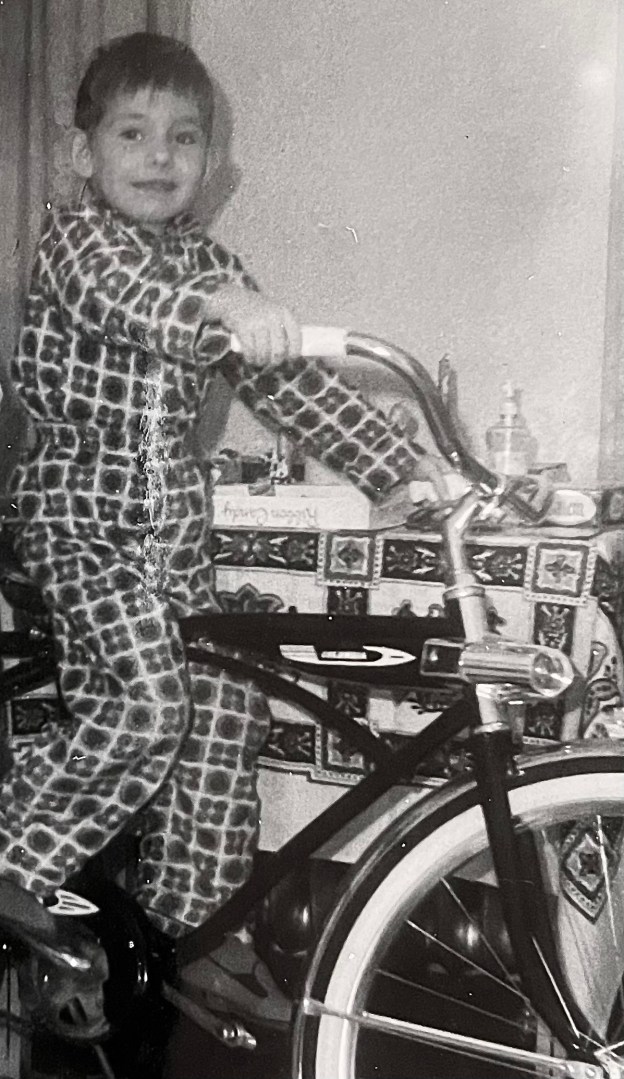
Two gifts awaited me under (and beside) the tree. And, honestly, of all the presents on all the Christmas mornings of my childhood, they are the only two I can still recall. One was a paint-by-numbers kit with a special kind of glittery paint. The other took my breath away. It was my first and only childhood bicycle, a 24-inch Columbia that I cherished immediately. Was it my imagination, or did it really glow?

No other conclusion was possible. I must have been a very good boy that year!

I looked across the room at Santa’s now smiling face.

She sees you when you’re sleeping. She knows when you’re awake.”

“God moments!”

—–

Philosophical proofs of God’s existence make my head spin. Try as I might, I just can’t follow the arguments; and, I’m honestly not edified by them. I don’t say this to disparage intellectuals, whom I greatly admire. It’s just that, if the world is comprised of thinking people and feeling people, I’m a card-carrying member of the latter group. In Myers-Briggs typology, I’m classified as an INFJ, which is a fancy way of saying that I lead with my heart.

My “proof” of God isn’t found in logic, reason, or even the theology I so dearly love. Rather, it’s found in the comradery of misfits, in laughter at the end of the pier, in frosty peepholes, and in Santa’s smiles and tender tears.

Yes, I still believe!